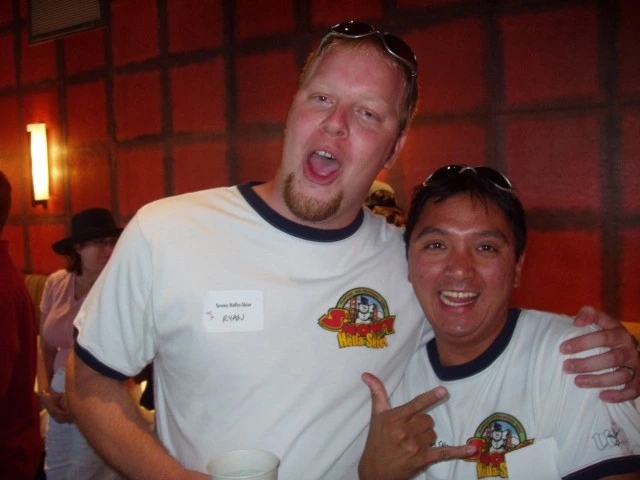
The Utah Pig Bus, the independent fan tailgate that has become a familiar part of University of Utah home football Saturdays, was founded by two Utah alumni and Phi Delta Theta Utah Alpha brothers: Welby Evangelista and Ryan Lufkin.
It started as a small tailgate in 1999. In 2002 they took in the pregame atmosphere at Michigan’s Big House, a full day of food, music, and strangers treated like old friends, and came home wanting that same spirit in Salt Lake City. In 2003 they offered to roast a pig for the football team. In 2004, during Utah’s undefeated, BCS-busting season, then head coach Urban Meyer invited them to roast the first team pig in his backyard. The crew dates the Pig Crew from that gathering.
In 2005, the official start year for Porky, they brought home a retired 1987 Bluebird school bus from Oakland, California, with Dean “Deano” Pruitt as Porky’s original driver on the trip to Bountiful, and rebuilt it as Porky: a crimson rolling kitchen, gathering place, and mascot, lettered “Utes Pig Bus.” They set up in the Guardsman lot at 527 Guardsman Way, Salt Lake City, a short walk from Rice-Eccles Stadium, and kept showing up for whole hog roasts, bacon explosions, themed menus, and a welcome that extends to visiting fans. Ryan’s wife, Amanda Lufkin, and longtime crew member Steve Kirk have been part of building that welcome.
Evangelista and Lufkin also wrote a weekly tailgating series for KSL.com in 2014, pointing readers to the Guardsman lot, the team walk, and the craft of a whole-hog roast. Lufkin has told the story on The Tailgate Connect Podcast (2025) and in Salt Lake television interviews, including FOX 13’s 2024 report on the Bacon Balcony, the roof deck built with metalworker Ryan Morgan ahead of Utah’s first Big 12 season, and a 2026 KUTV conversation about more than two decades in the lot. National game-day shows have stopped by as well, including ESPN College GameDay and FOX Big Noon Kickoff.
Through all of it, the founders have described the same idea: friends, food, and hospitality, week after week, whether the Utes are celebrated or tested. The Pig Bus is an independent alumni tailgate, not a university program. It is a crew that built a bus, a table, and a community, and still parks it in the same lot. Go Utes.
Who started it?
Two friends. One brotherhood. A lifetime of adventures.
The story of Welby, Ryan, the Pig Crew, and everything that happened before Porky.
The Utah Pig Bus didn’t begin with a bus. It didn’t begin with a parking space, a football game, or even a roasted pig.
It began with friendships.
Welby Evangelista and Ryan Lufkin, two University of Utah alumni and proud Phi Delta Theta fraternity brothers from the Utah Alpha chapter, helped turn a collection of college friendships into something that would eventually become one of the University of Utah’s longest-running and most recognizable tailgating traditions.
Welby Evangelista
Co-founder of the Utah Pig Bus
University of Utah alumnus and Phi Delta Theta brother from the Utah Alpha chapter. Welby has been part of the tailgate since the first pop-up shade, and co-wrote the crew’s 2014 tailgating series for KSL.com.
Ryan Lufkin
Co-founder of the Utah Pig Bus
University of Utah alumnus and Phi Delta Theta brother from the Utah Alpha chapter. Ryan co-wrote the 2014 KSL.com series and told the Pig Bus story on The Tailgate Connect Podcast in 2025.
But to understand the Utah Pig Bus, you have to go back a little further. Back before Porky. Before the elaborate menus, the crowds, the television appearances, and the annual pilgrimage to Rice-Eccles Stadium.
Back to a group of fraternity brothers who graduated from college but never really graduated from having adventures together.
What followed was a collection of unlikely experiences involving homemade flying machines, Red Bull Flugtag competitions, Jimmy Buffett-inspired parties, basketball tournaments in Las Vegas, whole roasted pigs, and eventually a retired short bus from Oakland, California.
There wasn’t a grand business plan. Nobody was trying to build a brand, start an organization, or become a fixture of Utah football culture.
They were simply friends who enjoyed getting together, dreaming up something entertaining, and finding ways to make the next gathering a little more memorable than the last.
And somehow, those gatherings became a tradition that has endured for more than two decades.
The brotherhood before the bus.
Once a Phi Delt, always a brother.
The story begins at the University of Utah, where Welby and Ryan were members of the Utah Alpha chapter of Phi Delta Theta.
Like countless fraternity brothers before them, they discovered that college was about considerably more than classes, exams, and eventually earning a degree. It was about friendships, shared experiences, and meeting people who would become part of their lives long after the diplomas were handed out.
Fraternity life has its own peculiar way of creating lasting bonds. People from different backgrounds, with different personalities, interests, and ambitions, find themselves living together, working together, arguing over things that don’t matter, and occasionally accomplishing things that probably shouldn’t have been attempted in the first place.
Those experiences have a way of bringing people together.
And while the college years eventually ended, the friendships didn’t.
The group grew older. Careers began. Families were started. People moved away, returned, and moved away again. The responsibilities of adulthood began to compete with the freedom of college life.
But there was still a desire to get everyone together.
That became the underlying motivation behind many of the adventures that followed.
The idea was simple: Find an excuse to bring the guys together, make the excuse entertaining enough that everyone wants to show up, and create something worth remembering.
Sometimes that meant a trip. Sometimes it meant a competition. Sometimes it involved building something ridiculous.
And sometimes it meant figuring out how to roast an entire pig.
The important part was never really the activity.
It was getting everyone together.
Before Porky: the original adventures.
Flying machines, Parrotheads, basketball, and a few questionable ideas.
Long before the Pig Bus became the centerpiece of Utah football Saturdays, the crew had already developed an appetite for unusual adventures.
There were Red Bull Flugtag events in San Francisco and Portland, the Parrothead Phis, and March Madness basketball tournaments in Las Vegas.
These weren’t merely parties. They were excuses to plan something, build something, travel somewhere, compete against somebody, or simply reconnect with friends who might otherwise go months or years without seeing one another.
Each adventure helped establish a culture that would eventually define the Utah Pig Bus: friendship, imagination, hospitality, competition, humor, and a willingness to put a little more effort into having fun than most reasonable adults would consider necessary.
Adventure one: Red Bull Flugtag, San Francisco
The dream of flight. The reality of gravity.
Somewhere along the way, somebody decided that building a homemade aircraft and launching it from a platform over water sounded like a terrific way to spend time with friends.
Enter Red Bull Flugtag.
For the uninitiated, Flugtag is a competition in which teams design and construct homemade flying machines, then attempt to launch them off a platform over water.
The objective is to fly.
The reality, more often than not, involves an enthusiastic crowd, a brief moment of optimism, and a spectacular demonstration of gravity.
Naturally, it was exactly the kind of thing the crew wanted to do.
San Francisco provided the stage for an adventure that combined creativity, engineering, teamwork, travel, and the sort of good-natured absurdity that has always characterized the group.
But behind the humor was something more meaningful.
A project like Flugtag takes planning. Somebody has to come up with the idea. Somebody has to convince everyone else that it’s a good idea. Somebody has to help build the contraption, organize the trip, and coordinate the logistics.
And then everybody has to show up and participate.
That dynamic would become familiar years later when the Pig Crew began organizing increasingly elaborate tailgates.
The aircraft might or might not fly.
But the friendships were doing just fine.
Adventure two: Red Bull Flugtag, Portland
Because apparently once wasn’t enough.
Most people who build a homemade flying machine, push it off a platform, and watch it descend toward the water consider the experience a once-in-a-lifetime adventure.
The Pig Crew isn’t necessarily composed of most people.
So the Flugtag adventure continued in Portland.
Another city. Another event. Another opportunity to bring everyone together around a project that combined imagination, competition, and a healthy disregard for the probability of actual flight.
And another chance to enjoy everything that happens around the main event.
The travel, the preparation, the conversations, the inside jokes, and the stories told afterward were every bit as important as the competition itself.
That became one of the enduring characteristics of the group.
An event is something you attend. An adventure is something you share.
The distinction matters.
Years later, the same philosophy would transform an ordinary football tailgate into something much larger.
Adventure three: The Parrothead Phis
A little Jimmy Buffett. A lot of brotherhood.
Not every adventure required an aircraft.
Some simply required the right attitude.
The Parrothead Phis combined the laid-back spirit of Jimmy Buffett’s Parrothead culture with the enduring friendships of Phi Delta Theta.
The idea wasn’t terribly complicated.
Bring people together. Turn up the music. Enjoy the company. And embrace the notion that, at least for a little while, everybody could leave the stresses of everyday life behind.
It was part fraternity reunion, part tropical celebration, and part reminder that enjoying life doesn’t have to stop once you leave college.
There was something particularly fitting about combining Phi Delta Theta brotherhood with Parrothead culture.
Both, in their own ways, celebrate belonging.
Both bring together people who might otherwise have little in common.
And both are built around shared experiences that become familiar traditions.
More importantly, the Parrothead Phis helped reinforce an idea that would later become central to the Pig Bus:
You don’t have to take yourself too seriously to take your friendships seriously.
The gatherings were meant to be fun, but the relationships behind them were lasting.
And that distinction became increasingly important as the group grew older.
Adventure four: March Madness, Las Vegas
Basketball was the excuse. Brotherhood was the point.
Then there were the Las Vegas basketball adventures.
March Madness already has a way of bringing people together. Throw in Las Vegas, a group of competitive fraternity brothers, and an organized basketball tournament, and you have the ingredients for an entirely different kind of reunion.
The tournaments offered an opportunity to compete, reconnect, and revisit a little of the camaraderie of college.
There were games to play, teams to organize, and the usual collection of personalities that comes with any group of friends who have known each other for years.
Some of the guys were competitive. Some were social. Some were probably convinced they were still as athletic as they had been at twenty-one.
But everyone understood the larger purpose.
It wasn’t about winning a championship.
It was about maintaining the friendships that had started years earlier at the University of Utah.
As careers, marriages, children, and everyday responsibilities increasingly occupied everyone’s time, these adventures provided something valuable: a reason to get together.
And that reason was usually enough.
The Las Vegas tournaments, the Flugtag adventures, and the Parrothead Phis were different experiences, but they shared the same underlying spirit.
How a brotherhood tradition became a Utah football tradition.
In 2003, the University of Utah had a new head football coach named Urban Meyer.
Utah football was entering an exciting new chapter, and the program was about to begin one of the most remarkable periods in its history.
Welby and Ryan saw an opportunity to contribute in a way they knew how.
They reached out to Coach Meyer with a simple offer.
They roasted whole pigs and would love to do one for the football team.
It wasn’t a corporate sponsorship proposal. It wasn’t a fundraising campaign. There was no marketing department, advertising strategy, or elaborate presentation.
Just a couple of Utah alumni offering to cook for their football team.
In a university community where football is often about much more than what happens between the sidelines, it was a gesture that reflected something familiar: alumni supporting the next generation of Utah athletes.
Coach Meyer responded positively to the idea.
The invitation led to a meeting at the football offices, and eventually plans were made to roast a pig for the team before the 2004 season.
The event took place at Coach Meyer’s home, before summer camp, with the goal of bringing players and people together around a shared meal.
And, as everyone who has ever participated in a pig roast knows, cooking an entire pig isn’t quite the same as throwing a few hamburgers on the grill.
It requires preparation, patience, time, and a fair amount of effort.
But that was part of the attraction.
A pig roast is more than a meal. It’s an occasion.
It gives people a reason to gather, stay awhile, talk, laugh, and get to know one another.
The crew had always understood that.
Now they were bringing that philosophy to Utah football.
2004: The year Utah busted the BCS.
And a tradition found its home.
The 2004 Utah football season became one of the most celebrated in the university’s history.
Led by Urban Meyer and quarterback Alex Smith, the Utes completed an undefeated season, earned a berth in the Fiesta Bowl, and became the first team from a conference without an automatic BCS berth to break into the Bowl Championship Series.
Utah had busted the BCS.
For Ute fans, it was a defining moment.
For Welby, Ryan, and the growing Pig Crew, it was also the beginning of a tradition that would take on a life of its own.
The pig roast had created a connection between something they loved doing and a university they loved supporting.
And rather than treating it as a one-time experience, they kept doing it.
Season after season.
The roasts continued. The gatherings grew. Friends invited friends. Fraternity brothers brought their families. Alumni returned to campus, and eventually people who had no connection to Phi Delta Theta became regular members of the extended Pig Crew.
The food became more ambitious. The gatherings became more elaborate.
But the basic idea remained unchanged.
Cook something extraordinary. Invite people over. Enjoy Utah football together.
And always make room for somebody new.
Coaching eras are listed to place the tailgate in time. They do not imply that the University of Utah or any coach owns, runs or endorses the Pig Bus.
The tailgate before the bus.
A pop-up shade, a grill, and an open invitation.
It’s worth making one important distinction.
The Utah Pig Bus tradition existed long before there was an actual Pig Bus.
In the beginning, there was no giant rolling tailgate headquarters. No elevated viewing deck.
Before
What they saw at the Big House
A road trip to Ann Arbor to watch Utah play Michigan showed them what game day could be: tents and grills covering the grass, and strangers treated like old friends. They came home wanting that for Utah, and wanting it open to everybody. Come as you are. Bring a friend. Meet an opposing fan. Stay for a meal.
1999
A shade, a cooler and a grill
Friends started tailgating together in 1999. As Welby and Ryan later told KSL.com readers, it began with a pop-up shade, a cooler and a grill. There was no bus, no roasting box and no plan beyond spending game day with friends.
The box
Nothing draws a crowd like a pig
A co-worker sent them a story about La Caja China, a Cuban-style roasting box made by a small company in Miami. They called, talked to the owner, and ordered what they have described as the first box the company shipped to the Western U.S. The tailgate had its signature.
2005
A bus named Porky
The roasts needed a home. In 2005 they bought a retired 1987 Bluebird school bus, drove her home through northern California and Nevada, and rebuilt her with the crew into Porky: kitchen, gathering place and mascot.
A bus and a roasting box are equipment. What Welby and Ryan built with them is a place where Utah fans, alumni and visiting fans spend game day together.
Everybody eats
From the start the tailgate was open: Utes, neighbors and visiting fans all get a plate. In their 2014 KSL.com column they wrote that USC fans treated them so well at the Coliseum, at Utah’s first Pac-12 game, that they began roasting a pig for every home USC game to return the favor.
A contest they will never win
They came up with the idea for the Crimson Club tailgate cooking competition and helped write its rules. That is why they have never entered to win. The point was to get the whole lot cooking.
Teaching the lot to tailgate
In the 2014 season they wrote a weekly tailgating series for KSL.com: how to start, how to cook a whole pig, what to do when it snows, and why Guardsman Way can hold its own against any tailgate in the country.
A stage on the roof
Porky’s roof deck has held a full band. Live music, DJs, birthdays, milestones and even weddings have happened aboard the bus.
National TV, same parking lot
The crew and the food have been on the ESPN College GameDay set and on FOX’s Big Noon Kickoff. The cameras were welcome. The tailgate is still for the people in the lot.
Brothers and friends
Many of the Pig Crew are fellow Phi Delts, and a brother from any chapter has a standing invitation aboard Porky. So does everybody else.
In their own words, and in the press
Read and listen.
The columns they wrote, and the coverage and interviews since. Every title opens the original.
Welby Evangelista and Ryan Lufkin, University of Utah alumni and Phi Delta Theta brothers from the Utah Alpha chapter.
When did they start tailgating?
Friends have tailgated together since 1999. The Pig Crew dates to 2004, when the crew roasted the first team pig in Coach Urban Meyer’s backyard, and Porky the bus joined in 2005.
What did they do before the bus?
They tailgated with a pop-up shade, a cooler and a grill. With their Phi Delta Theta brothers they also built flying machines for Red Bull Flugtag in San Francisco and Portland, held the Parrothead Phis gatherings and played in March Madness basketball tournaments in Las Vegas.
Do the founders work for the University of Utah?
No. The Utah Pig Bus is an independently organized alumni tailgate tradition. It is not owned, operated, sponsored, endorsed, or officially affiliated with the University of Utah, Utah Athletics, the Crimson Club, or Phi Delta Theta Fraternity.
How do I reach the founders?
Email the crew at porky@xmission.com or use the contact form. A person on the crew reads every message. Contact the crew
Come say hello
Easy to find.
The crew is in the lot every home game, at 527 Guardsman Way, Salt Lake City. Look for the red bus and the smoke from the roaster.
The Utah Pig Bus is an independently organized alumni tailgate tradition. It is not owned, operated, sponsored, endorsed, or officially affiliated with the University of Utah, Utah Athletics, the Crimson Club, or Phi Delta Theta Fraternity.